


Great to be on board. This is exactly the kind of film I love to make.
What you're about to read builds directly on everything we've talked about: the chain reaction, the transitions, the comedy, the community. The script gave us a great skeleton, and this document is the muscle. How I see the film beat by beat, how we make the game world bulletproof, who our heroes are, and how sixty seconds carries all of it without a single dead frame.
One note before you dive in. Nothing here is decoration. Every idea in this treatment protects the same thing: that lightning-in-a-bottle moment when someone screams "how did you do that?!" and can't rest until they find out.
Let's find out together.
Petr

Sixty seconds, fully loaded.
The whole film on one screen. Ten beats, three heroes, one question, and not a single dead frame. Scroll the timeline, then watch it happen in the story section.
Sixty seconds sounds short until you load it right. Every beat in this film does at least two jobs: a laugh and a hand-off, a product moment and a story turn. The transitions carry the baton. Gags keep the pulse up. And the easter eggs? Those belong to the community. One question carries everything, whispered, mocked, typed, screamed.
This isn't a script squeezed into a minute. It's a minute engineered beat by beat, for an audience that decides in three seconds and rewards every second that earns the next.
One second to stop them. Three to win them.
Our audience decides in one second and commits in three. Not because they're impatient. They're trained. The feed taught them to smell filler, and they're one thumb-flick from something else at all times. So no warm-up, no establishing. We open at full throttle and make skipping feel like a mistake.
That's the hook: a promise of how the whole film will feel. Big, fast, funny, fluent. By the time "YOU LOSE" hits the screen, the audience is asking the exact question the film is about.
We win them in three seconds. Then we spend fifty-seven earning the rewatch.
Watch it in your head.
Ten beats, sixty seconds. Every hand-off is a transition, every transition is an idea. And one question travels through it all, whispered, mocked, typed, screamed, until every voice that asked it walks into the arena with the crowd. Here's the film as I see it.


We open inside the game, full cinematic mode. A colossal sci-fi bridge. Two figures charging at each other: Anna Key, small and fearless, and NIL-EGO, a mech the size of a building. Earth-shaking footsteps. They halt just feet apart, and for two seconds we go full western. Extreme close-up on Anna Key's eyes. Extreme close-up on the mech's optic lens. A glitchy low-poly tumbleweed rolls across the bridge. High noon, patch v2.4.7.
At peak tension, a half-second smash-cut: Lenny, perched on a chunk of ruin nearby, paw deep in a popcorn bucket, eyes wide. Back to the fight.
The mech winds up for a massive attack, and Anna Key's arm cannon fires an anti-grav ray. NIL-EGO ragdolls off the bridge the way physics engines ragdoll: limbs everywhere, dignity nowhere, deeply funny. A huge "YOU LOSE" hits the screen.


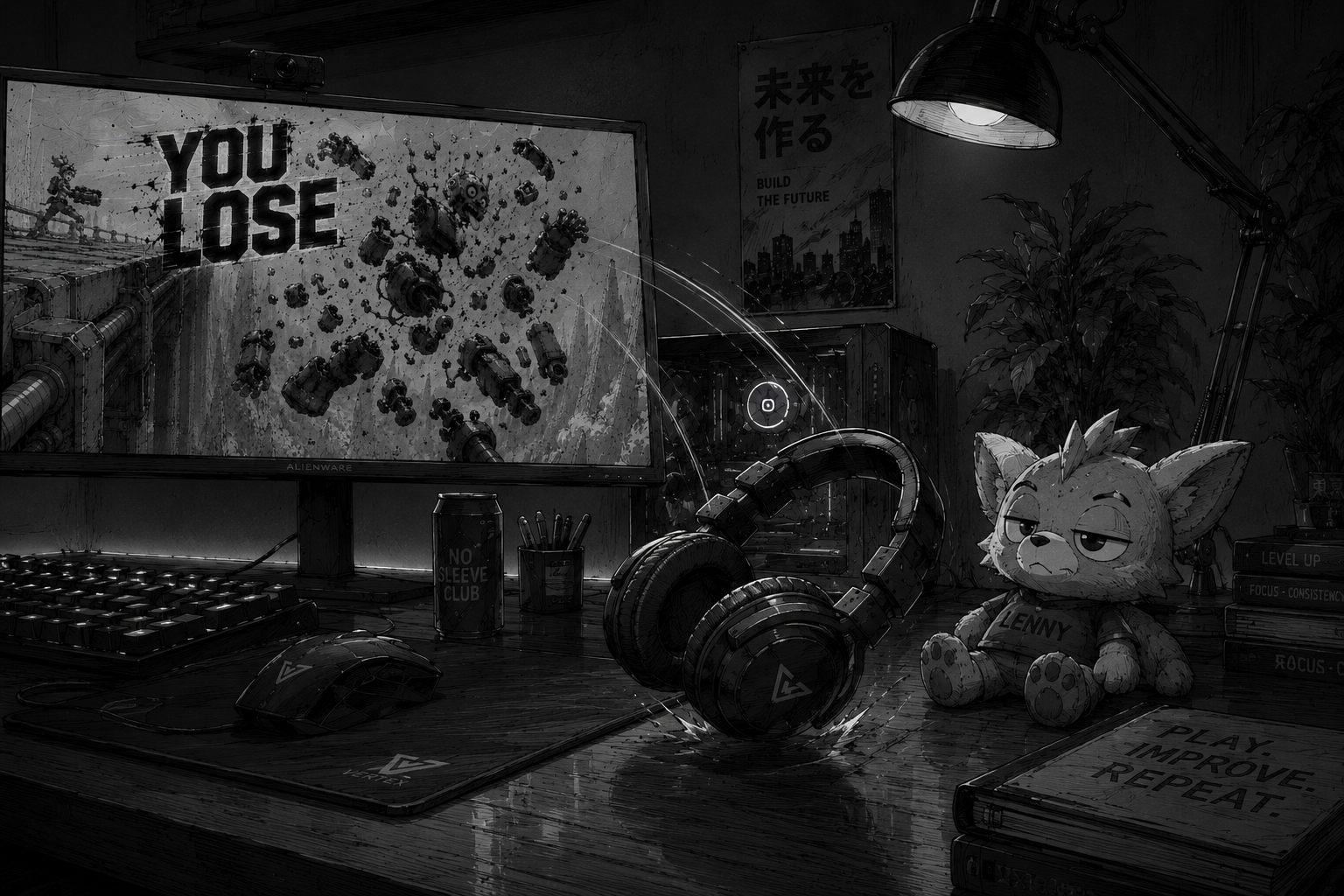


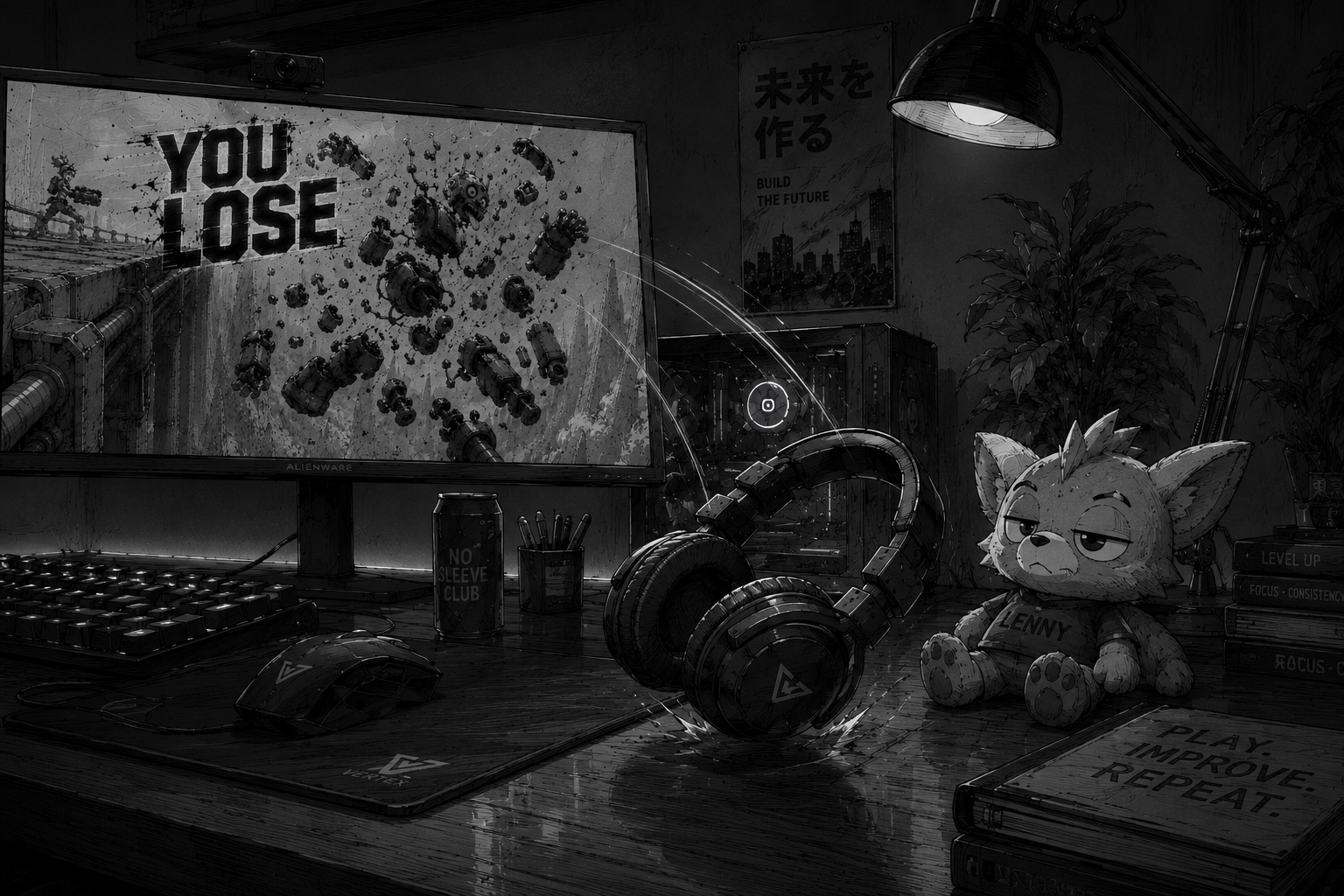


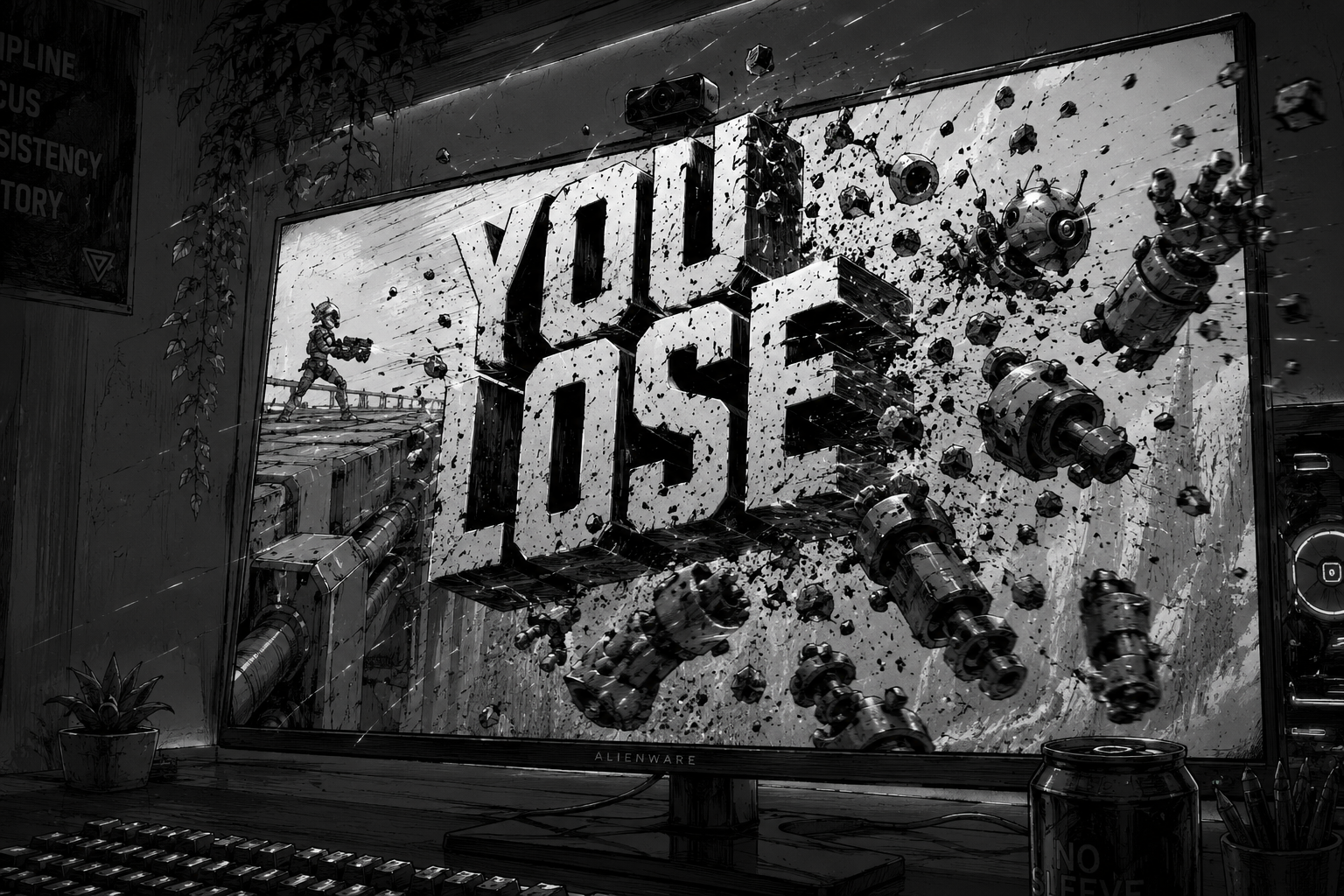
We pull out through the "YOU LOSE" screen, text reading the right way round because we're on Sam's side of the glass, into a real bedroom. Sam rips off his headset and it arcs across the desk in the exact same ballistic curve the mech just flew, landing next to a Lenny plushie. The plushie doesn't react. It has seen this before.
"HOW DID THEY DO THAT?!"


Sam types "How do you…" and the internet buries him. Browser tabs don't stay on the monitor. They spill past its edges, stacking up around him in the room, walls of threads and thumbnails closing in. "Why Mech is the most OP character". "15 reasons not to play Mech, unless you want to suck". Reddit wars, Discord build guides. Somewhere in the flood, one thumbnail looks suspiciously like a creator you might recognize.
He picks up the Legion Go 2 without leaving his chair, the search still running in his hands. In front of him the monitor gives up and drifts into its screensaver: Lenny, bouncing around the empty desktop, pulling faces, doing tricks for nobody. He clicks a video: "How to get OP in 5 mins". Runtime: 2 hours 35 minutes. A sigh. Playback speed: 4x. And for half a second, our film obeys: the cut, the music, Sam's movements, everything runs at 4x.
Then he plays. The "YOU LOSE" screens don't disappear. They stack, tiling into a grid. Four. Nine. Sixteen windows of defeat. Then one single cut: a clean screen.
But we don't cut straight to battle. We cut to a killcam: Sam replaying his own death from Beat 1, studying it, scrubbing the timeline. The game itself narrates what went wrong. One cut from replay UI to live gameplay, and a massive game headline slams across the frame: REMATCH INITIATED. The mech charges Anna Key again.
This time he's ready. Before she can fire her signature move, NIL-EGO lifts off the bridge, red and blue heat blooming through his plating as the whole back unfolds into a missile rack. He empties it. The bridge disappears in white.
Flash-cut: Lenny behind the same rock, popcorn flying everywhere.
"VICTORY" emblazons the screen.
Same victory screen, but now we're looking at it through a semi-transparent laptop display, "YOU LOSE" mirrored across the face of Alex. Same camera move as Sam's reveal, opposite direction: with him we pulled out of defeat, with her we look into it. Defeat reads differently from the other side of the glass.
Her excitable friend wrenches the laptop away, laughing at her: "How did you do THAT?" Alex spins it back. And quietly, almost to herself, she whispers it again: "No, seriously… how did they do that?" Then she starts typing it, into a search bar, mid-sentence, cursor blinking. The question stops being spoken. It becomes an action.
Cut from the blinking cursor in a text field to the cursor in CAD. Alex on her Legion rollable, rotating a 3D model of the mech. She drags a slider: the robot separates into an exploded view, and the screen physically expands to hold it. The camera keeps moving, up and over the screen onto her desk, where for one breath her tools and components levitate in the same exploded composition. Digital and physical, one grammar.
She clicks, scales, spins and twists every part, then slams them back together. The reassembled mech looks like a scrapyard's idea of a sculpture. Nothing where it should be, everything somehow still attached. Close-up on the mech's face. Sad binary bleeps, and the subtitle types itself out in sync, one bleep at a time: "Why did you do that…" the last word hanging on a loading stutter "…?" Even his disappointment buffers.
She scraps it and builds her own character from nothing. Shapes pull themselves out of the grid: a weapon, then armour, then a pair of wings that shouldn't work and absolutely do. She hits save: "character_FINAL_really_final_v67". The T-posed model goes online. Likes, hearts and thumbs up rain through the room around her, and the character comes alive, in-game.
A cosplay workshop. Max watches the launch trailer of Alex's character on her Legion laptop, absolute awe on her face: "How do I MAKE this?"
A high-energy montage, all in close-up. A blade opening a sheet of foam. A print head sprinting back and forth. Glue where glue shouldn't be, and a yelp. Paint hanging in the air. And time is honest here. Jump cuts let day turn to night behind the window, the desk clutter grows, energy drink cans multiply, a workshop blueprint stamped MK.III. This takes weeks, and the film respects that.
Max connects two cables. LEDs flicker to life, then short her entire workshop into darkness. One by one, the LEDs re-ignite in the dark, sketching only the silhouette of the finished cosplay. That's all we get. The full reveal isn't ours yet.
A camera flash throws us onto a convention floor, and the flash IS the reveal: the finished cosplay, seen properly for the first time, mid-photo, looking incredible. Glory earned.
As Max walks out of frame, crash zoom onto a cosplayer behind her wearing a laughably amateur cardboard version of the same armour. Admiration and jealousy in one look: "How did you do that?" A strip of tape gives up. The cardboard wing hits the floor.
He picks it up, presses the tape back down, and walks on. And in his eyes, for half a second, the exact same spark Sam had when he started typing "How do you…"
Another flash. Esports fans drift past with hand-written signs: TEAM ANNA KEY, NIL-EGO LIVES, fan-art of both bosses. This game has fandoms. They push open double doors, we fly into the darkness with the roar of a crowd rising, and under it, layered like a chant, every voice that asked the question: a whisper, a laugh, a scream. Pillars of light ignite an epic stage: the silhouette of a gamer at a Legion battlestation, screens running v3.0.0.
Close-up: Sam lowers his headphones, determined. The first syllable of the shoutcaster lands over his face, sound ahead of picture, and as we cut to the end card it explodes: "HOW. DID. THEY. DO THAT!?"
End card: Lenovo Legion. Reach Your Impossible. On the product screen, the in-game victory plays out. And the very last detail before we go: the Lenny plushie, sitting on the battlestation desk. It travelled. It has seen the whole thing.
Transitions you'll want to rewind.
Let's be clear about the craft here: this film cuts hard. Fast, confident, meme-fluent hard cuts do the everyday work. That's the native rhythm of the content our audience lives in. But on the seams that matter, every time the question jumps from one person to the next, one world to the next, we spend a transition. Ten moves, all motivated by story, none of them decoration. A transition in this film is an event, never wallpaper.

The screen is the membrane between worlds, and we cross it twice, in opposite directions. With Sam, we pull out through "YOU LOSE", text reading correctly: we're leaving the game with him. With Alex, we look in through her semi-transparent display, text mirrored: we're meeting defeat from the other side of the glass. Same camera language, inverted meaning. That inversion IS the baton pass.
The mech ragdolls off the bridge, and one cut later Sam's headset flies off in the exact same ballistic arc, landing next to the plushie. The game's physics leak into the bedroom for half a second. Small object, same curve, instant connection.
Sam sets the tutorial to 4x, and the film itself obeys: cut, music, movement, everything sprints for half a second. The interface doesn't just sit on screen, it directs the film. A joke every viewer under thirty feels in their body.
We don't cut from grind to rematch. We cut to the game's own replay of Beat 1, Sam studying his death, scrubbing the timeline, and one cut takes us from replay UI to live gameplay. The game narrates its own turning point. No transition in this film is more native to gaming than this one.
Alex whispers the question, then starts typing it, and we cut from the blinking cursor in her search bar to the cursor in CAD. The question literally becomes the work. Typing is how this generation asks. The cut just follows their hands.
Alex explodes the mech in CAD, the rollable's screen expands to hold it, and the camera keeps moving, over the screen and onto her desk, where her tools levitate in the same exploded composition for one breath. Digital and physical, one grammar. The motif returns on Max's workbench: foam pieces laid out like a diagram, an exploded view you can touch. One idea, three worlds.
The camera flash isn't just a cut, it's a curtain. The blackout in the workshop gives us only a silhouette; the flash on the con floor gives us the finished cosplay, properly, for the first time. Tease in the dark, reveal in the light. Then a second flash carries us toward the arena doors. Same device, escalating stakes. And the flash is always diegetic: a real photographer on the con floor, a real fan outside the arena. Light that actually fired in the scene, not a filter added in post.
We hear the next scene before we see it: the crowd rumbling behind closed doors, the shoutcaster's first syllable landing on Sam's face before the cut. Sound doesn't follow this film. It leads it. (Full arrangement lives in Sound & Music.)
Physical movement passes the baton just like screens do. Alex's friend yanks the laptop: whip pan. Max swings the x-acto knife: the cut flies with the blade. A hand grabs an energy drink: crash zoom somewhere else. The camera doesn't wait for actions to finish. It steals their momentum. Rougher, more handheld, less calculated, and exactly the crash-zoom, whip-pan energy this chain reaction runs on.
Each of these will be boarded, prevized and locked before the shoot. Transitions this precise are built in prep, not discovered in the edit. Reference reel drops in here: one moving example per move, so nobody has to imagine anything.
Places, not sets.
Every space in this film belongs to someone. Not dressed for camera. Lived in, worn in, earned. These are the rooms this generation actually lives in, r/battlestations truth instead of catalogue fantasy, and they'll clock a fake in one frame: the too-clean desk, the cable management nobody actually has, the RGB placed by a stylist instead of an owner. So we build the way our heroes live. One rule across all of it: if it looks art-directed, it goes.
A real gamer bedroom, straight from the community. Screen light and RGB as the primary sources, daylight fighting through half-closed blinds. Posters layered over older posters, an empty energy drink graveyard, headset wear on the chair. The Lenny plushie sits where a real one would: not displayed, just there. This room needs to feel like 2 a.m., because that's when the grind happens.
A creator's corner: drawing tablet, sketches taped to the wall, a chair that's seen better days, the rollable as the centre of gravity. Slightly tidier than Sam's world, she makes things and order helps, but still real: reference prints, half-finished ideas, one dying plant. The light is cooler, screen-led, focused. This is where curiosity has a desk.
This one we treat with extra love, because the brief asks for it and the community deserves it. A real cosplay workspace, built with real cosplayers as consultants: EVA foam sheets and offcuts everywhere, a 3D printer mid-job, heat gun, contact cement, sandpaper grades lined up, worbla scraps, reference boards, a blueprint stamped MK.III. Materials shown honestly: foam dust, glue strings, burnt fingertips. These are not theatre costumes and never will be. Cosplay is engineering with passion, and the set design has to say so before a single line of dialogue could. Time lives here too: day turns to night behind the window, clutter grows, the build takes the weeks it really takes. And we bring the community in properly, with cosplayers consulting on the build, the materials and the details that only they would catch. This scene isn't about depicting cosplay culture. It's made with it.
The game world is a location, and we scout it like one. The bridge, the ruins, Lenny's popcorn rock: designed with game-logic geography, lit and graded in the same visual language as the live action, so crossing between worlds feels like walking through a door, not switching channels.
The finale deserves its own scale. A real venue with real depth, not a black studio with lights pretending. Darkness first: we fly through the double doors hearing the crowd before we see it. Then the pillars of light ignite and build the space in one reveal: the stage, the Legion battlestation, the silhouette. Haze in the air so the light has body, hand-painted TEAM ANNA KEY and NIL-EGO LIVES signs in the crowd, fans who treat a game like a stadium sport. Because for this audience, it is one. This is the one moment the film goes big-room cinematic, and it's earned: three stories climbed here. The stage light is the payoff of every desk lamp before it.
One production design language across all of it: authentic first, cinematic through light and lens, never through polish. Real places photograph better anyway. They come with ten years of set dressing no art department could fake.
One frame of fake kills the film.
Gamers watch 40 hours of gameplay a week. They know exactly what a game looks like, how it moves, how it feels. The moment our game world looks like an ad pretending to be a game, we lose the entire audience. So we build it like a game, with people who play.
Real UI, real physics, real logic. Health bars that behave like health bars. Hit feedback that lands. Anna Key's anti-grav ray follows game rules, not VFX rules: the mech ragdolls the way physics engines ragdoll, slightly broken, deeply funny. Ragdoll comedy is a genre the community loves, and we're using it on purpose.
Every gamer knows the moment a game cuts from gameplay to a pre-rendered cinematic. The light changes, the motion smooths out, the truth leaves the room. Our in-game world stays on the gameplay side of that line. Game-logic camera, in-engine feel, the grit and texture of something being played right now. Cinematic comes from the framing and the story, never from polishing away the game.
The size mismatch is the joke, the personality gap is the story. A colossal mech with a fragile ego. A warrior with one absurdly overpowered move. We treat their scene like a scene: staging, timing, comedic beats. And we light and grade the game world with the same eye as the live action, so both halves of the film speak one visual language.
Mid-standoff, at peak tension, we smash-cut to Lenny: perched on a chunk of ruin nearby, paw in a popcorn bucket, eyes wide. Half a second. Back to the fight. The eternal spectator, watching the battle the way we watch the film. And when the plasma missiles fly in the rematch, one more flash-cut: same rock, popcorn everywhere. A mascot doesn't need lines. He needs a moment the community will clip, loop and meme by lunchtime. Back in the real world, a Lenny plushie sits quietly on Sam's desk. Two worlds, one fuzzball. If you know, you know.
This half of the film lives or dies in prep. I board very specifically, we previz the full in-game sequence, and we lock one route with our post partner before the shoot, not after it. Everyone renders toward the same target from day one. Lenny's cutaways are boarded and prevized with the same care as the boss fight itself: one location, two shots, zero seconds stolen from the story. And as a gamer, I sit in the middle of that conversation, client, agency, post. I speak both languages, and I'll be the most annoying quality check in the room.

You can't act 3,000 hours of gameplay.
The most expensive mistake this film could make is casting actors who hold a mouse like it's a prop. Our audience has watched thousands of hours of real players: streamers, teammates, themselves. They know what focus looks like at hour six of a session. They know the micro-flinch of a lost clutch. None of that can be performed. It has to live in the person, so we cast from the community and its orbit, not the catalogue.
Stylish, charismatic representatives of Gen Z. Fresh faces, not the usual casting-database rotation. People with a real relationship to gaming, who know the community and its world from the inside. Interesting personalities with strong, expressive faces, comfortable in front of a camera but never performing for it. People who can simply be themselves, because themselves is exactly what this film needs.
He feels everything at full volume. Every defeat is the end of the world, every victory is the best day of his life, and his face broadcasts it all one second before he knows it himself. He's the friend you want watching your game, because his reactions are better than the game. When he rips off that headset, the whole audience has been him. And when he walks onto that stage at the end, they're all walking with him.
She loses the match and wins the film. Where everyone else sees defeat, she sees a locked door, and she's already looking for the key. There's a particular kind of quiet intensity we're after: the person at the party who's half-listening because their head is already building something. Her whisper, "no, seriously… how did they do that?", is the smallest moment of the film and the biggest. It's the sound of curiosity switching on.
Max falls in love easily, with a character, a craft, a challenge, and then gives it everything. Burnt fingertips, three a.m. deadlines, an apartment full of foam dust: that's what devotion looks like in her world. Her face watching that trailer is the purest emotion in the film, childlike wonder on an adult with power tools. Max comes from the cosplay community itself. Not an actor playing a maker, a maker playing herself. Anything less and the community sees straight through it.
I wasn't sure at first whether Max should be a man or a woman, and honestly both work, but a woman feels stronger here. The cosplay community is largely built and led by women, so a woman with a heat gun and a foam sword is simply truer to it than the default. It also balances our trio: two women, one designing, one building, neither of them the sidekick. Open for discussion either way.
Alex's friend gets the mocking version of the question: comic timing over screen time. The cardboard cosplayer carries the film's heart in two shots, the fall and the spark that says his own story is just beginning. And the arena crowd are real fans, not extras told to cheer. Key rows filled from the community, people who know how to lose their minds at a play.
Shot loud. Cut fast. Heard first.
Energy isn't an accident of pacing. It's every craft pulling in the same direction, built to keep a trained audience exactly where we want them: leaning in.
The entire dramaturgy of this film is engineered with a Gen Z mindset at its heart. This is the most demanding audience in the history of moving images: raised on infinite choice, fluent in every format, armed with a skip button. So the storytelling gives them no reason to use it. Fast, action-packed, cause-and-effect narration where every beat launches the next, every scene ends on a question the following scene answers. No establishing padding, no dead air, no scene that exists just to explain. The story doesn't slow down to be understood. It's built so clearly that full speed IS understandable. That's the trick: not shorter attention spans, higher standards. We're not fighting their attention. We're respecting it.
Hard cuts do the everyday work, fast and confident, the native rhythm of the feed. But rhythm isn't speed, it's contrast. We sprint through the grind, then hold half a second on Alex's whisper. We let the 4x gag literally accelerate the film, then plant our feet for the western standoff. Every slowdown makes the next sprint hit harder. Sixty seconds that feel like thirty and reward a rewatch like ninety.
Shot to be screenshotted.
This film has to look expensive and feel real at the same time. Cinema craft wearing streetwear. Rich, textured, atmospheric images with imperfections left in on purpose: a little grain, a little flare, light that behaves like light. Our audience lives in an over-polished, filter-smooth visual world; the fastest way to earn their trust is to look like nothing else in their feed. More cinematic than content, more honest than advertising.
not a spectator
The camera work is where this film flexes. Action-packed, dynamic, impossible to look away from, camera language borrowed straight from gaming itself: killcam sweeps, replay orbits, spectator-mode dives, the sudden snap of a hard-scope. Whip pans stolen from a yanked laptop, crash zooms triggered by a falling cardboard wing, long dynamic takes that ride the energy while it’s hot. Every move is designed to be eye-catching and immersive, the kind of shot that makes you feel the game instead of watching someone play it. We keep a breath of handheld and a few human imperfections so it never turns sterile. But make no mistake: this is epic filmmaking with a controller in its DNA.
The toolkit stays varied on purpose: motion control for the moments that need surgical precision, Steadicam for the flows, classic handheld for the truth, and the switches between them are a rhythm of their own. Just when the eye settles into one language, we change it. That variety is how sixty seconds keeps surprising: the audience never learns the pattern, so they never stop watching.
The film is a journey from small light to big light. Sam’s room: screen glow and RGB as the only truth-tellers, a face lit by defeat long after midnight. Alex’s space: cooler, focused, screen-led, the light of concentration. Max’s workshop: warm practicals, the hot orange of a glue gun, LED tests flickering across her face, light literally being built by hand. And the arena: pillars of light, haze with body, the one big-room cinematic moment of the film. The stage light is the payoff of every desk lamp before it. One arc, told entirely in sources that exist in the scene.
Contrast and depth over brightness and safety. Blacks that are actually black, highlights that bloom like screens really bloom, colour driven by the worlds themselves: RGB spill, monitor cyan, workshop amber, arena blue-white. The game world gets its own heightened version of the same palette, bolder and more saturated, unmistakably a game, so both realities rhyme without matching. Grade unifies, never sterilizes.
Foam dust in a light beam. Fingerprints on a screen. Condensation on an energy drink. The audience can’t consciously name why a frame feels true, but their gut runs on texture. We shoot close, we shoot tactile, and we let the worlds stay a little dirty. Real places, real materials, real light: that’s the look. Everything else is lens and instinct.
They hear footsteps through walls. They'll hear us.
Gamers are the most sound-trained audience there is. Their games taught them to read audio like radar: footsteps behind a wall, a reload three rooms away, the half-second cue before an ultimate drops. They don't just hear sound. They act on it. An audience this trained notices lazy audio instantly. It also rewards great audio like nobody else. And the same goes for music. This is a generation with a playlist for every mood and zero tolerance for a track that sounds like it was chosen by a committee. Our score has to be punchy and catchy, build the atmosphere, carry the flow and stay in people's heads long after the film ends. The goal is simple: a soundtrack they'd actually save to their own playlist. Sound and music are one craft here, and we treat them that way from the first day.
We hear the next scene before we see it: the crowd rumbling behind closed doors, the shoutcaster's first syllable landing on Sam's face before the cut. Sound is this film's forward gear. It pulls the viewer through every hand-off half a beat before the image confirms where they've landed.
Mouse clicks, mechanical keyboards, the printer's whir, the flick of a foam blade, a glue gun's hiss, the pop of a camera flash. We record the real thing, close and tactile, and cut it into the rhythm track of the film. Half the energy of the edit will come from sounds you could touch. Game audio gets the same respect: real UI bleeps, hit feedback, the anti-grav ray's whoosh. Designed like game sound, not movie sound, because the community knows the difference blindfolded.
Music matters. Sound design matters just as much, and on a film this fast it might matter more. That's why I want Samuel Jurkovič on this, one of the best sound architects working today, with global campaigns for LEGO, Pepsi, ASUS and BMW behind him. What makes Samuel different is that he builds every sound from scratch in his studio instead of pulling from stock libraries or leaning on production audio. Nothing is borrowed, so nothing sounds borrowed, and we get complete creative freedom to shape every hit, whoosh and click exactly the way the edit wants it. He's the kind of talent who can find a rich, surprising sound in a moment or an object you'd swear was silent. In a film where a glue gun, a slider and a popcorn bucket all have comic timing, that skill is not a luxury. It's the difference between funny and very funny.
The HDYDT?! refrain travels as sound design: screamed, mocked, whispered, typed, and finally roared. Each delivery bleeds a trace into the next scene, layering scene over scene, until the arena doors open and every voice that asked the question walks in with the crowd, assembling into one chant beneath the shoutcaster's final "HOW. DID. THEY. DO THAT!?" One question, building the whole film like a beat drop.
The score is composed for this film, not licensed onto it. Writing it from scratch means the music and the sound design are built on the same grid, so the gags, the chant and the drops all land together instead of negotiating with each other in the mix. For this I'd love to work with Lukas Mutnansky, a brilliant composer who has written for brands like Coca-Cola, Škoda, Footshop, Oktagon and T-Mobile, and who understands exactly this kind of pacing. The track has to survive the loudest test there is: sounding great at full volume in headphones, where this audience actually lives. And it has to move with the picture, not behind it. Every hit, every turn, every drop locked to the cut, so the music and the film feel like they were made in the same room. Because they will be.

This film speaks maybe twenty words out loud, and that's the point. The question in its variations, a binary complaint with subtitles, a shoutcaster losing his mind. No explaining, no banter, no voiceover walking us through what we can see. Every line that survived is doing real work, which is exactly why each one lands. Show, don't tell. And when you do tell, make it quotable.
The tech doesn't appear. It performs.
The brief says it best: the product cannot be a passive prop. So every Legion device in this film has a job in the story, a beat it drives, a moment that wouldn't happen without it. Nobody pauses to admire hardware. The hardware is too busy doing things. And that's the only integration this generation accepts: they smell product placement from a mile away, so the products have to live in the story instead of posing in it.
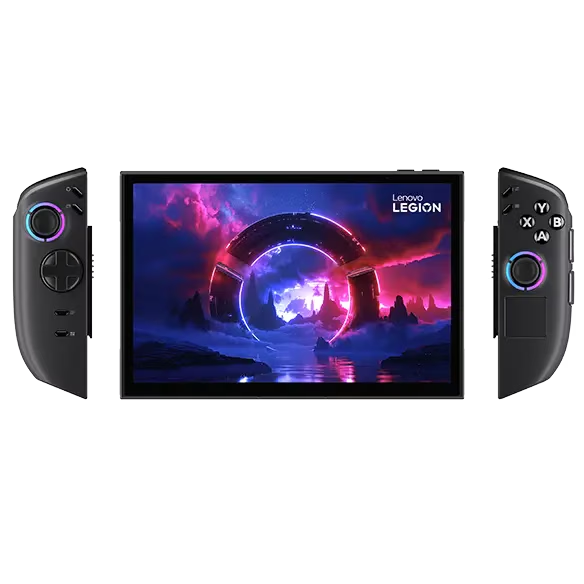
The Go carries the hardest-working stretch of the film. Tutorials at 4x on the couch, build guides in bed, one "YOU LOSE" after another. The grind goes wherever Sam goes, because the Go does. The product as a training montage, a habit lived on screen. Every gamer watching knows exactly what that handheld glow at 2 a.m. means.
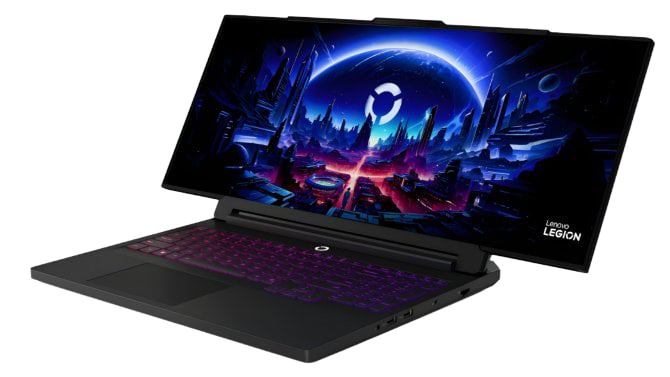
The single most cinematic product moment of the film, and it's earned: Alex drags the exploded-view slider and the screen physically expands to hold her ambition. The product does something impossible at the exact second the story needs something impossible. Form factor as plot point. This is the beat the campaign gets remembered by, and it belongs to the Rollable.
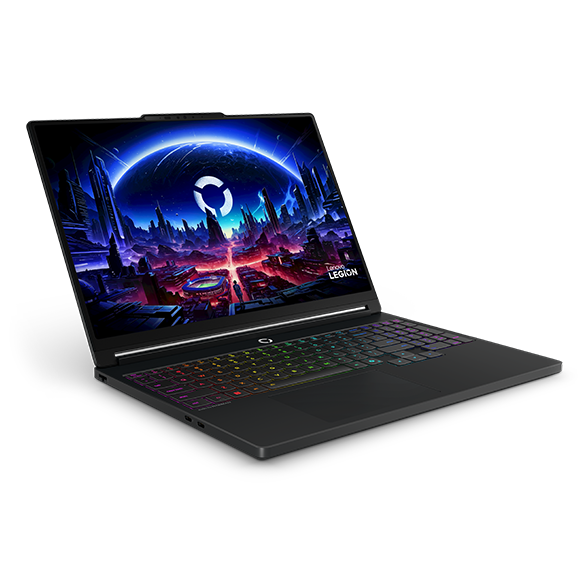
Alex meets her defeat through one (that semi-transparent YOU LOSE is a Legion screen) and Max meets his inspiration on one, watching the launch trailer that starts his build. No feature theatre. Just the quiet credibility of being the machines this community actually reaches for.
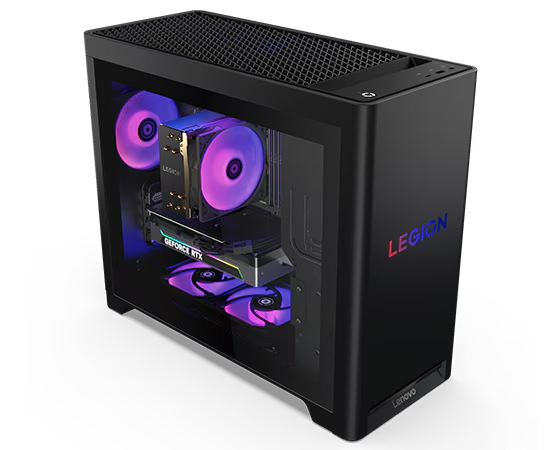
The heart of Sam's battlestation at home: the RGB heartbeat of the room, the machine the whole bedroom orbits. It frames the defeat in Beat 2 and quietly anchors where this journey started when we reach where it ends.
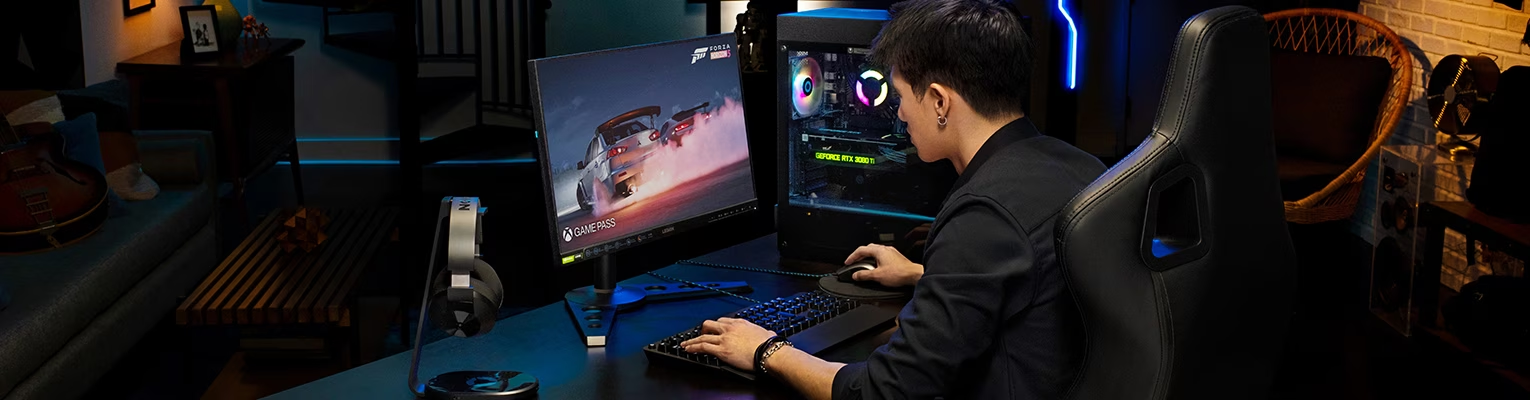
The full Legion ecosystem assembles for the finale: tower, monitor, keyboard, mouse, headset, stage light hitting the complete setup like a boss arena. It's the one moment the film flexes hardware openly, and it can afford to. By then, every device on that stage has already earned its place in the story. The stage doesn't sell the gear. The journey did.
Headphones, mice, keyboards, mousepads, backpack, the Lenny plushie. Set dressing that's actually set truth, placed where real players place them. Never arranged, never labelled. If you know the gear, you'll spot it. If you don't, you'll just feel that these rooms belong to people who play.
If you know, you know.
Two layers of funny run through this film. The surface layer needs zero context: things break, fall, short-circuit and explode at exactly the wrong moment, and anyone with eyes laughs. The deeper layer is written in the community's native tongue, jokes that only land if you've spent your life in game lobbies. The first layer makes the film work. The second makes it belong.
The brief asks for comedy that doesn't lean on dialogue, and that's our instinct anyway: every gag lands visually, in one frame, with no setup tax. A mech ragdolling with zero dignity. A glue gun scalding. A whole apartment blacking out. A cardboard wing giving up on cue. You could watch this film on mute in a feed, which, let's be honest, is where half the audience will meet it, and every joke still works. Sound makes them funnier. Silence doesn't kill them.
The funniest things in this film are reactions: the plushie that doesn't react at all, Lenny's popcorn mid-standoff, the binary complaint that buffers on its own disappointment, the half-second of pride before the wing drops. We direct comedy like music. It's all in when, not what. And we protect the beats in the edit: a gag that needs a breath gets a breath, even in a sixty-second sprint.
The community layer is built for the rewatch and the comment section: patch numbers ticking up across the film, character_FINAL_really_final_v67, the MK.III blueprint, TEAM ANNA KEY signs in the crowd, a thumbnail that looks suspiciously familiar, a fuzzball with popcorn who's seen every frame of this story. None of it interrupts the film. All of it rewards attention. The first viewing entertains. The second one recruits. Give a community things to find, and they'll do the distribution for you.
One line we don't cross: we laugh with our heroes, never at them. Sam's rage is lovable, Max's scalding is endearing, and even the cardboard cosplayer gets his dignity back two shots later. His fail is the beginning of his story, not the punchline of ours. In this community, everyone's been the noob. The comedy remembers that.
Vertical isn't a crop. It's a version.
This campaign lives on the internet. That's not a constraint, it's the brief: two years, global, every screen except the ones in living rooms and cinemas. So we don't shoot a TVC and slice it up afterwards. We shoot a system.
This film is built to come apart. Every beat is written to make sense on its own, which means the cutdowns inherit real stories instead of highlights. Three fifteens, three complete arcs:
Hook: the standoff and the ragdoll. Payoff: VICTORY. A full story of defeat, obsession and a comeback.
Hook: YOU LOSE mirrored across her face. Payoff: her own character alive in the game. The complete arc of curiosity turning into creation.
Hook: the launch trailer that stops him mid-thought. Payoff: the con floor, the glory and the cardboard wing. Craft, start to finish.
The 30 is the film with the connective tissue trimmed, not a rushed version of it. The 6s are single gags that need zero context: the ragdoll, the wing, the blackout. And the 10s for TikTok get treated as their own creative, platform-native from the first cut. The YOU LOSE grid alone is a TikTok-shaped idea: grid stacking, hard cut, victory. Born vertical, not converted.
We design key scenes for multiple ratios from the boards up: 16:9, 9:16, 1:1 and 4:5 all get real compositions, not center-crop survivors. On set that means protecting the frame edges, staging action that works tall AND wide, and shooting selected setups twice where the formats genuinely want different framing: the exploded view, the arena reveal, the YOU LOSE wall. Nothing in post should ever have to apologize for how it was shot.
The 4x5 loops and carousels come from moments engineered to loop: Lenny's popcorn, the buffering binary complaint, the LED silhouette igniting. And the lifestyle photography rides the shoot itself: same worlds, same light, same truth. Fifteen product images that look like frames from the film, because they practically are.
Everything above shares the visual DNA: same grade, same energy, same easter-egg logic. A person who meets this campaign as a 6-second gag, a carousel, or the full film should recognize it instantly as the same world. That consistency is what makes a campaign feel like a universe instead of a media plan.
One refrain, five deliveries, one circle. The film has a built-in engine that no amount of production trouble can break: as long as the question keeps travelling, the film keeps working. Structure this strong is rare. Our job is to charge it, not carry it.
Every gag lands in one frame, works on mute, and loops like it was born to. This film doesn't need a media plan to be watched. It needs one to keep up. The ragdoll, the wing, the popcorn: each is a self-contained piece of internet before it's a scene in a film.
The Rollable expands because the story does. The Go carries the grind. The battlestation is a throne that three stories earned. Product integration this organic is what "cool, not corporate" actually looks like on screen, and it's why the audience won't flinch when the logo lands.
Real faces from the community, real rooms with real mess, real materials with real burns, a game world built with game logic. In a feed full of brands doing an impression of gaming culture, authenticity isn't a style choice. It's the moat.
Easter eggs for the rewatch, quotable lines, clippable gags, a mascot with popcorn, a question everyone's already said out loud. The film is designed to be taken apart, memed and passed on, which is exactly what the story is about. Form and content, same mission: HDYDT?! stops being our campaign and becomes their catchphrase.